
Every startup begins with an idea, but ideas do not pay rent, hire engineers, or build a product. Somewhere between a founder’s first pitch and a company’s first paying customer, there is a funding gap that banks will not touch and most venture capital firms consider too early. Angel investment fills that gap. Understanding what is angel investment matters because it explains how thousands of young companies survive their first, most fragile years.
The term sounds informal, almost old fashioned, but the practice behind it has funded some of the most recognizable companies in the world long before they became household names. Founders often start asking what is angel investment the moment a bank turns them down and a venture capital firm says it is too soon. The answer sits somewhere between personal savings and institutional finance.
What Is Angel Investment
The simplest way to explain what is angel investment is this. It is money that a private individual, usually a wealthy professional or a successful entrepreneur, puts into an early-stage company in exchange for equity or convertible debt. Angel investors use their own money, not funds raised from other people, which sets them apart from venture capital firms.
Angel checks typically arrive after a founder has exhausted savings, credit cards, and contributions from family and friends, and before the company is large enough to interest a formal venture capital fund. The amounts vary widely. Some angels write checks for a few thousand dollars. Others, especially those investing through a syndicate or an angel network, commit hundreds of thousands of dollars to a single deal.
What separates angel money from a bank loan is risk tolerance. A bank wants collateral and a repayment schedule. An angel investor accepts that most early startups fail and expects a handful of successful bets to cover the losses from the rest. That risk appetite is precisely why angel investment exists where traditional lending will not go.
How Angel Investors Support Early-Stage Startups
Once a founder understands what is angel investment, the natural next question is what an angel actually brings beyond the check. Angel investors rarely stop at writing one. Many have built and sold companies themselves, and they bring that experience into the boardroom. A founder gets someone who has hired a first sales team, negotiated a lease, or navigated a failed product launch and lived to tell the story.
This mentorship matters because early startups make dozens of small decisions that can shape the next five years. Should the company raise prices before or after its next funding round? Is it time to hire a chief financial officer? An experienced angel investor has usually faced these questions before and can shorten the learning curve considerably.
Angel investors also open doors. Introductions to a potential customer, a future co-founder, or the venture capital firm that will lead the next round often matter as much as the check itself.
Why Women Angel Investors Are Reshaping the Space
Angel investing has historically been a male dominated world, built around informal networks of successful entrepreneurs who already knew each other. That is changing. Women Angel Investors are a growing share of the angel investing community across the United States, the United Kingdom, and India, and their numbers have climbed steadily over the past several years.
Dedicated groups have formed specifically to support Women Angel Investors, including Golden Seeds in the United States and women focused angel syndicates that have emerged in the UK and India. These networks give first time investors structured education, deal flow, and a community of peers, which lowers the barrier for women who want to start investing but were previously shut out of informal, male dominated deal rooms.
This shift is also changing which founders get funded. Investors tend to back people and problems they understand, and a more diverse investor base tends to back a more diverse set of founders. Startups pitching to these investors often report being asked sharper questions about long term sustainability and customer retention, not just growth at any cost.
What Startups Should Know Before Approaching Angel Investors
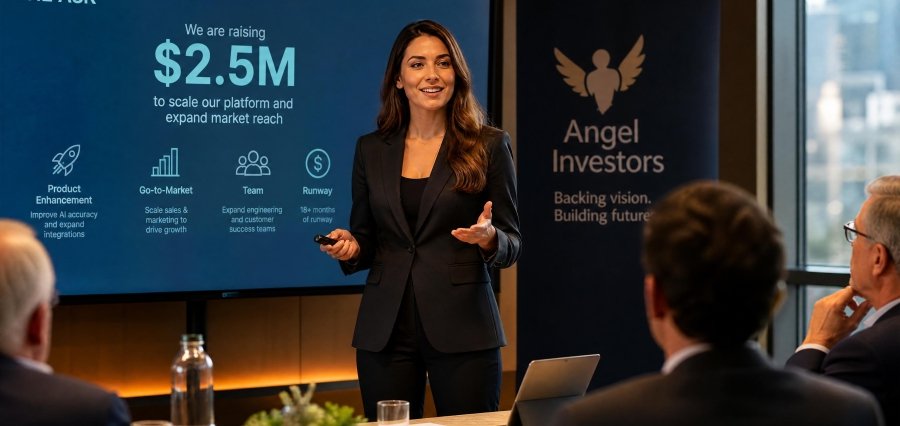
Founders researching what is angel investment should also learn how to approach one. Angels invest in people first and ideas second, so a clear, honest pitch matters more than a polished slide deck. Investors want to know what the money will be used for, how far it will stretch, and what milestone it will help the company reach.
Due diligence still applies, even at this early stage. A serious angel investor will ask about the market, the competition, and why this particular founder is positioned to win. Founders should be ready to answer plainly rather than lean on jargon.
It also helps to remember that angel investment is not free money. In exchange for the check, the investor typically receives equity, a seat at the table, and a stake in the company’s future. That relationship can last for years, so founders should treat the search for an angel investor the way they would treat hiring a long term business partner.
Conclusion
What is angel investment ultimately comes down to a simple exchange. A private individual takes on early risk that banks and most institutional investors will not touch, and in return, they get a stake in a company’s future. For startups, that early capital, combined with the mentorship and introductions that come with it, often makes the difference between an idea that fades and a company that survives long enough to raise its next round. As more Women Angel Investors enter the field and bring new perspectives to who gets funded, the angel investing world is slowly starting to look more like the founders it backs.