
Prime Highlights :
- Women researchers at King Fahd University of Petroleum and Minerals are contributing to research in artificial intelligence and cybersecurity.
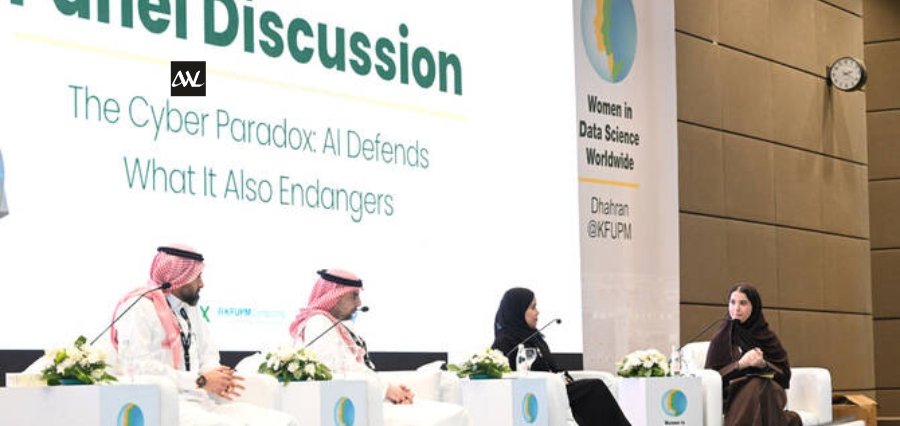
- The university’s Women in Data Science conference brought together experts and students to discuss emerging challenges at the intersection of AI and security.
Key Facts :
- Doctoral candidates Asma Yamani and Linah Ali Abuhajar are among the first generation of women to study and graduate from KFUPM after it opened to women in 2019.
- The conference attracted around 250 participants and featured a poster competition with 85 submissions from KFUPM and other local universities.
Background :
A team of women scholars at King Fahd University of Petroleum and Minerals is focused on research in artificial intelligence and cybersecurity. Among them are doctoral candidates Asma Yamani and Linah Ali Abuhajar.
King Fahd University of Petroleum and Minerals, a STEM focused institution founded in 1963 as an all male university, began admitting women in 2019. The researchers featured belong to the first generation of women to study and graduate from the university, and building a supportive research community became an early priority for them.
That effort recently culminated in the university’s annual Women in Data Science conference, held under the global WiDS Worldwide initiative with the theme AI Security Nexus. The event drew around 250 attendees from across the region and was organized by a team of five students led by Yamani, who has supported the conference since women first enrolled at the university.
Yamani recalled that the conference began in 2019 as the university’s first female graduate students enrolled, but the COVID-19 pandemic forced the event online just before speakers were set to arrive. The conference later shifted to a hybrid format before returning fully in person this year.
A poster competition tied to the event attracted 85 submissions from the university and other local institutions, with cash prizes awarded to the top three entries.
Speakers from academia and industry addressed topics including securing the AI era, large language model security, Arabic hate speech detection, and AI governance in fintech, with participants representing organizations such as Saudi Aramco, Mastercard, and the University of California, Los Angeles.