Smart agriculture based on advanced technology is reshaping the global farming sector in a highly effective manner. It leads to higher yields, better resource efficiency, and helps in the environmental protection efforts spread over the agricultural landscapes. Farmers, to tackle the climate change issues and to be able to supply more food, are digitalizing their farm operations and purchasing automated machines that increase productivity and make it more precise. The shift to technology-based farming is not simply changing the tools used in the agricultural system, but it is actually changing the whole system itself, in a fundamental way. Farming ecosystems are being transformed at the root level as they become increasingly reliant on data-driven insights and real-time decision-making. Such capabilities are altering modern farming considerably. Most of this transformation is attributed to the rapid innovations of sensors, drones, IoT devices, and artificial intelligence. By allowing more precision and less waste, smart agriculture makes the food production systems more resilient in the long term and contributes to global agricultural sustainability.
Smart Precision Farming
Precision farming technologies form a core component of the smart agriculture system. This method uses GPS-enabled equipment, soil sensors, and aerial imaging to identify the precise locations where targeted interventions are required. By these means, farmers are capable of mixing fertilizers, watering, and spraying only in the places where these are absolutely necessary and thus, they save the inputs and reduce the release of harmful substances to nature. Ultra-modern farm data allows farmers to detect changes in soil qualities, moisture, and nutrient levels. This knowledge serves for correct planning, saving resources by displacing the obsolete and inefficient fertilizer application methods, and ensuring farm sustainability in the long run.
Additionally, data analytics is another factor that has an immense impact on agriculture. Basically, it is the transformation process of farm data into the most useful insights. Through the application of farm management software, farmers are able to monitor weather changes, predict crop yields, and plan harvesting times with greater accuracy. In addition, predictive analytics plays a critical role in identifying potential pest outbreaks or impending drought conditions. Farms equipped with precision agriculture can increase output, reduce waste, and maintain more stable and predictable production cycles. These improvements form a strong foundation for sustainable growth, creating a win-win scenario for both productivity and environmental stewardship.
Smart Farm Automation
Automatization has become one of the most significant components of modern agri-business. The use of self-driving tractors, robotic welders, and automatic irrigation systems is very common among farmers, as they want to lessen the labor and increase the efficiency of the operation simultaneously. These devices are made to carry out the same tasks repeatedly with accuracy and uniformity, which in turn, raises the productivity level. In addition, automation is beneficial in solving the problem of labor shortage which has been a trend in rural and agricultural areas. By reducing the need for manual labor, farmers can focus on strategic decision making and crop planning, enhancing the resilience and growth potential of their farms.
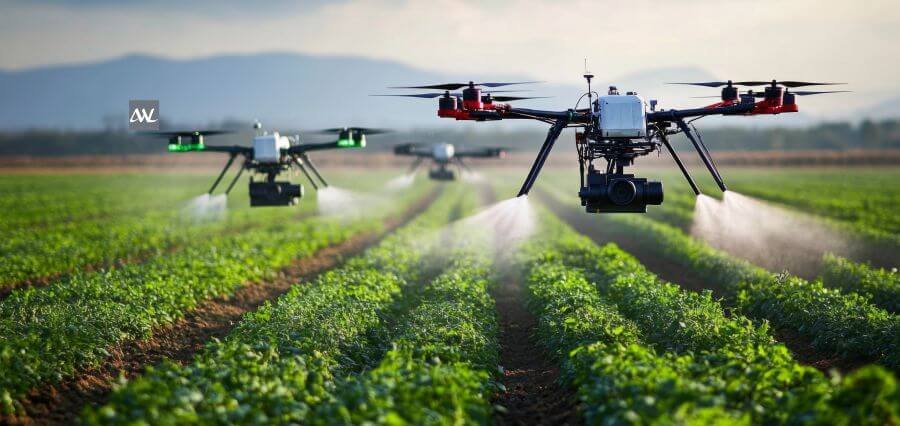
Drones are another tool that have been a major driver of change in various use cases. Equipped with multispectral cameras and the most modern sensors, drones can analyze the health of crops, detect diseases, and, in a matter of minutes, cover large areas of land. Besides that, the use of drones for planting and spraying allows the accurate application of pesticides and fertilizers, thus making the process safer and lessening the chemical use. The implementation of robotics and drones in agriculture is the main reason why operations are being done on time and in a more efficient way, which in turn results in increased yields, improved crop quality, and the possibility of intervention at exactly the right time.
Sustainable Farming with IoT
Smart farming technologies support environmentally friendly agriculture by reducing environmental impact and maintaining economic viability. IoT enabled sensors installed on farms provide farmers with real time updates on soil moisture, temperature, and nutrient levels. An automation of irrigation, which is linked to these sensors, can therefore make water consumption different by the actual state of the soil. In this way, water that would have been wasted is saved and the crops receive the water they need. IoT-powered irrigation is, therefore, the best water-saving strategy in drought-affected areas, at the same time, agricultural productivity can remain at a good level, and farm resilience can be guaranteed in the long run.
Technology infused with intelligence is the main enabler for the seamless integration of renewable energy resources and the embracement of green practices, thus leading to a rise in the overall eco-friendliness of the systems. Among the innovations that are present in the agricultural sector are solar-powered sensors, AI-managed crop rotation systems, and technologies specifically designed for waste minimization. These innovations have an enormous positive impact on the reduction of carbon emissions and, therefore, help to make the earth a safer place for the upcoming generations. Farmers nowadays are able to measure their environmental impact and implement practices that are in line with global sustainability goals.
Conclusion
Smart farming techniques are changing traditional agriculture to become more efficient, sustainable, and resilient. The use of data driven tools, automation, IoT systems, and advanced analytics allow farmers to have more precise and confident control over their fields. These technologies overcome the challenges of resource use, labor shortages, and climate variability which have been dealt with for a long time, thus leading to the creation of an agricultural environment that is both more controlled and adaptable. Therefore, farming is changing to a tomorrow-suitable industry capable of providing increasing food needs, saving earth’s natural ecosystems, and helping rural areas develop sustainably for a long time. As new technologies become less expensive and more accessible to farmers regardless of their size, the advantages of increased productivity, less waste, and better sustainability will be passed on to all the stakeholders in the agricultural value chain.