
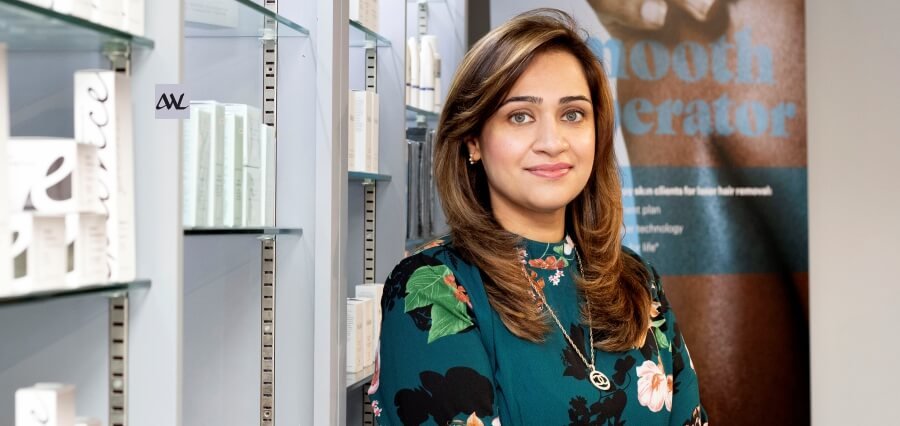
Leadership does not necessarily manifest in decisions that grab attention. It occurs during quiet times when individuals are inspired, empowered, and influenced positively. Leadership is defined by how a leader exercises accountability, creates trust, and disseminates information. Dr. Aiza Jamil does not define leadership through titles and positions. Rather, she understands leadership as being an activity defined by decisions, associations, and accountability. As a Consultant Dermatologist in Manchester, UK, she has built her career across two distinct healthcare environments. These experiences have enabled her to apply clinical skills and knowledge gained in the UK to the dynamic and internationally focused healthcare landscape of the Middle East.
Her philosophy of leadership is anchored in four core values: accountability, humility, integrity, and compassion. These define the way she treats her patients, supports her colleagues, approaches innovation, and handles change. Her definition of leadership revolves around what it achieves in terms of building trust, empowering people, and ensuring high standards of care.
Clinical Excellence and Global Leadership
Dr. Aiza’s professional journey began with the rigorous training of the UK medical system. This experience provided more than strong clinical skills. “My UK training gave me a strong foundation in evidence-based medicine, clinical governance, patient safety, and multidisciplinary collaboration,” she explains. It also shaped her understanding of the human side of medicine. “It taught me that behind every diagnosis is a person whose concerns, expectations, and quality of life must be understood.”
This belief has remained central throughout her career. Her move from Manchester University Hospital’s teaching hospitals to clinical practice in the Gulf broadened her perspective. Through her work with Mubadala Health and her continued commitment to Apogee Clinic, she has worked with a diverse and internationally informed patient population.
This experience has influenced how she views her role as a clinician. She sees herself not simply as a source of clinical knowledge, but as a bridge between global developments and local needs. Her approach focuses on adapting advances in dermatology to local realities while maintaining strong standards of evidence, safety, and cultural understanding.
Leadership Through Connection
Dr. Aiza defines leadership through connection rather than hierarchy. She describes her role as building bridges between clinical knowledge and innovation, different healthcare systems, and experienced professionals and the next generation. This approach reflects her belief that cultural and clinical differences can create opportunities for learning and growth rather than barriers to progress.
For Dr. Aiza, this approach is particularly important in dermatology. Skin conditions can affect far more than physical health. They can influence confidence, identity, and emotional wellbeing. “Skin conditions can affect confidence, identity, and emotional wellbeing, sometimes profoundly,” she says. This understanding has shaped her approach to patient care and team leadership. She believes clinical excellence and compassion are inseparable, with both playing an essential role in delivering meaningful care and building trust with patients.
Bringing contemporary Western dermatological knowledge and trends to the Middle East has also become an important part of her professional identity. However, she believes innovation must be adapted thoughtfully rather than imposed. Every new treatment or technology must meet four essential standards. It must be safe, clinically appropriate, supported by evidence, and genuinely beneficial to the patient. For her, innovation is valuable only when it improves patient care and creates meaningful outcomes.
Innovation with Clinical Purpose
Few fields evolve as quickly as dermatology. New treatments, devices, artificial intelligence, and personalized care approaches are changing the specialty rapidly. Patients also arrive at consultations with their own research and expectations. Dr. Aiza responds to these changes with discipline and careful judgment. She remains open to innovation but believes new ideas must always be supported by evidence.
Her professional experience gives her a broad perspective on this changing landscape. Her training in the UK developed a strong appreciation for evidence-based practice and clinical governance. Her work in Dubai has exposed her to a diverse international patient population that closely follows global developments in dermatology. Together, these experiences have shaped a collaborative leadership style. She actively values different perspectives and believes strong decisions come from listening and learning rather than relying on one authoritative voice.
For Dr. Aiza, humility is an essential part of professional leadership. Medicine continues to evolve, and established approaches must be reviewed as new evidence emerges. Leaders who remain open to learning are better positioned to adapt and maintain high standards of care. “Leadership is about evolving without losing sight of the fundamental principles of safety, ethics, and patient-centered care,” she says. This principle reflects her commitment to leading with knowledge, responsibility, and the needs of patients at the centre.
Accountability with Trust
For Dr. Aiza, effective communication begins with listening. She believes listening is essential to strong teamwork, patient safety, and trust. Her experience across different professional and cultural environments has strengthened this approach. She has learned to adapt her communication style to different situations while remaining consistent in her values of clarity, respect, honesty, and professionalism.
This adaptability also shapes how she builds and leads teams. She encourages colleagues to share their views, ask questions, and challenge ideas constructively. She believes this works best when people understand their roles and feel that their contributions are valued. Collaboration, she believes, must be balanced with accountability.
Accountability, however, should not be about blame. She views it as an ongoing process of taking ownership, learning, and improving. When something goes wrong, her focus is not on identifying who is responsible. Instead, she asks what can be learned and how the team can improve. This approach helps create a culture where people can pursue excellence while maintaining trust and psychological safety.
Empowering the Next Generation
Mentorship holds a personal place in Dr. Aiza’s professional life. Her own experiences of receiving guidance, facing challenges, and gaining encouragement at important career stages have shaped her approach. She does not believe a mentor’s role is to provide a fixed career path. Instead, she focuses on helping others recognize their strengths, build confidence, and realize their potential.
Dermatology continues to evolve rapidly, making continuous learning essential. Dr. Aiza encourages colleagues and aspiring dermatologists to remain curious and evaluate new evidence carefully. She also encourages them to develop interests beyond their clinical responsibilities. Leadership, research, education, innovation, and international collaboration can all contribute to a broader professional perspective. Her experience across different healthcare systems has reinforced the value of learning from colleagues around the world.
She also views mentorship as a two-way relationship. Younger clinicians bring fresh perspectives and strong technological knowledge that can broaden her own thinking. She considers seeing those she has supported develop their skills and grow into leadership roles one of the most rewarding aspects of her career.
Advancing Innovation with Purpose
Dr. Aiza identifies curiosity, critical thinking, openness, and the courage to question established approaches as essential leadership qualities that enable her to embrace innovation while keeping patient wellbeing at the centre. She makes an important distinction between two questions that clinicians may ask about new technology: “Can we do this?” and “Should we do this, and is it genuinely better for the patient?” She believes the second question should guide clinical decision-making.
Her international career has shaped this approach. Her UK training provided a strong foundation in evidence-based practice, clinical governance, and patient safety. Her experience in Dubai has given her a deeper understanding of an informed and internationally engaged patient population that closely follows developments in global dermatology. She sees her role as connecting these two perspectives. This means bringing contemporary Western dermatological innovation to the Middle East while considering evidence, safety, culture, patient expectations, and local clinical needs.
For Dr. Aiza, meaningful innovation is not about adopting something simply because it is new. Its value lies in its ability to improve patient outcomes and experiences. It should also strengthen confidence and quality of life. This patient-centered approach ensures that innovation remains focused on its true purpose.
Care with Integrity
At the heart of Dr. Aiza’s clinical philosophy is a simple belief: every patient should be recognised as an individual, not simply defined by their diagnosis. Dermatological conditions such as acne, pigmentation, scarring, hair loss, and inflammatory disease can have a significant psychological and social impact. This can be true even when a condition does not appear medically severe.
Listening is therefore as important as clinical assessment. Dr. Aiza believes clinicians need to understand not only the condition a patient has but also what it means to them personally. This understanding helps create care that is both clinically appropriate and responsive to each patient’s needs.
For Dr. Aiza, ethical leadership means ensuring that every treatment recommendation serves the patient’s best interests. This requires honest communication, realistic expectations, and transparency about uncertainty. It also means avoiding unnecessary interventions. This responsibility has become even more important as patients are exposed to large amounts of information and misinformation through social media. She believes clinicians have a duty to provide evidence, clarity, and reassurance rather than simply follow the latest trends.
Adaptability and Resilience
One of the defining challenges of Dr. Aiza’s career has been maintaining consistent clinical excellence while continuing to grow across different healthcare environments. Moving between the UK and the Middle East required significant adaptability. Healthcare systems, professional cultures, patient expectations, and approaches to clinical practice vary across regions. Navigating these differences required confidence, but it also required humility and a willingness to listen.
Rather than viewing these differences as obstacles, she treated them as opportunities to learn and grow. Her experience in the UK provided a strong foundation in clinical practice and governance. Her work in the Middle East expanded her understanding of how international dermatology can respond to diverse patient needs. These experiences strengthened her belief that leadership is about building bridges. It involves bringing together the strongest lessons from different environments to create more effective and resilient approaches.
Her career has also taught her that leadership does not require having every answer. It often means asking the right questions, seeking advice, and surrounding yourself with capable people. It also requires the resilience to keep moving forward when the path is uncertain.
Dr. Aiza believes resilience is built through preparation, experience, setbacks, and honest reflection. She views confidence not as the absence of doubt, but as the ability to move forward despite uncertainty. This perspective has developed through years of working beyond her comfort zone across different healthcare systems.
Throughout her journey, she has also learned not to compare her progress with that of others. Instead, she focuses on authenticity, patience, and the courage to recognize opportunities that align with her strengths and values.
Adaptability in Action
Looking back, Dr. Aiza identifies an important leadership milestone as one of the most significant moments of her career. Its value was not defined by the title it carried, but by the trust and responsibility it represented. She measures leadership by how that responsibility is used. For her, this means improving standards, encouraging innovation, supporting colleagues, mentoring younger clinicians, and ultimately improving patient care.
Looking ahead, she hopes to continue building meaningful connections between the UK and the Middle East. She aims to bring evidence-based innovation, emerging technologies, and high clinical standards to the region thoughtfully and responsibly. She also wants to support the next generation of dermatologists. She believes the future of medicine depends not only on technological progress, but also on clinicians who combine innovation with sound judgment, empathy, and strong ethical values.
Dr. Aiza does not want her legacy to be defined by a list of positions or achievements on a CV. She would rather measure it through the patients whose lives she has positively influenced, the colleagues and young clinicians she has supported, and her contribution to advancing dermatology across different healthcare communities.
For her, a meaningful legacy would show that innovation and compassion can work together. It would also demonstrate that international experience can connect healthcare systems rather than divide them. Most importantly, it would show that leadership can be ambitious while remaining deeply human.